
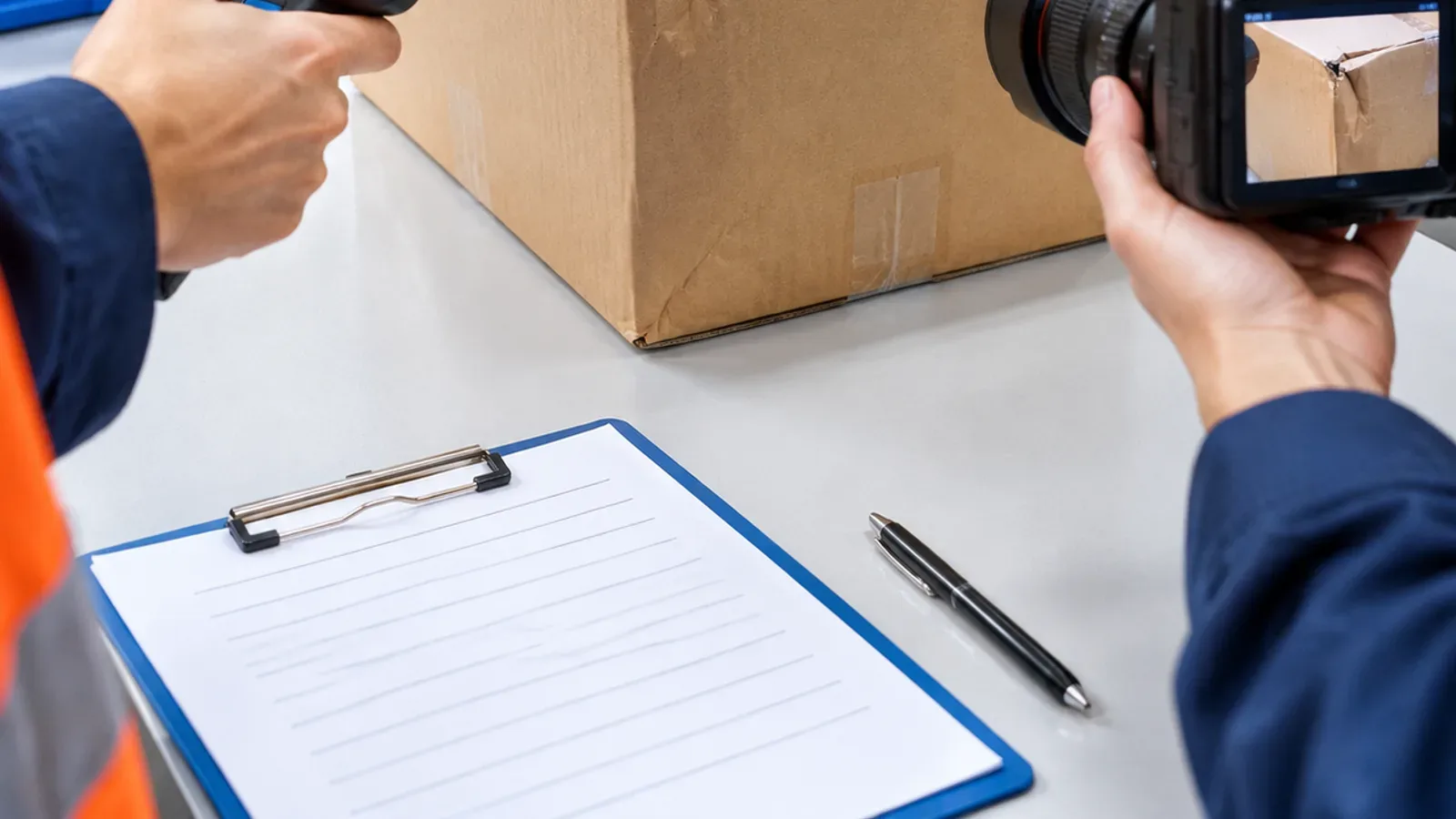
Direct answer: An FBA shortage or damage evidence file connects one shipment to its approved carton data, handoff condition, transport records, delivery proof, Amazon receiving result and follow-up. Capture time-stamped photos before pickup and at handoff, preserve carton and pallet identifiers, reconcile shipped versus received quantities, and check the current Amazon reimbursement and claim instructions before submitting. Evidence supports a review; it does not guarantee reimbursement.
This guide is for Amazon sellers, importers and operations teams moving inventory into an Amazon Fulfillment by Amazon receiving path. It focuses on what to preserve when cartons arrive short, visibly damaged, unidentified or with an inventory adjustment that does not match the shipping file. It does not decide whether Amazon, a carrier, a 3PL, an insurer or another party is legally responsible.
Reviewed: 16 September 2026. Amazon help pages, Selling Partner API documentation, carrier terms and insurance conditions can change. Recheck the live policy and the shipment facts before each escalation.
Key takeaways
- Give every discrepancy a shipment, carton or handling-unit reference.
- Separate origin condition, carrier custody, delivery condition and Amazon receiving evidence.
- Reconcile units and cartons before describing a shortage.
- Keep original photos and files with capture time, source and owner.
- Check the current policy and submission route before opening a claim.
Define the event before choosing a claim route
“Shortage” and “damage” describe symptoms, not a complete cause. A supplier may ship fewer units than planned, a carton may be lost or opened in transport, a delivery may be signed with visible damage, or an Amazon receiving process may post a quantity that differs from the submitted shipment data. An inventory adjustment can also appear after check-in without showing where the physical variance occurred.
Start the file with a neutral event classification and keep competing explanations visible. Use labels such as origin short-pack, carrier-visible damage, delivery exception, receiving shortage, unidentified carton, inventory adjustment or cause not yet established. Do not turn an assumption into a claim narrative merely because it is the easiest explanation.
The Amazon FBA inventory reimbursement policy is the controlling source for Amazon’s current program rules. It may distinguish lost or damaged inventory, eligibility, exclusions, evidence and submission handling. Read the live policy for the marketplace and date involved; this article intentionally avoids promising an amount, deadline or approval outcome.
Build the evidence file at origin
The strongest post-delivery review starts before the cargo leaves the supplier or origin release gate. Save the approved shipment plan, SKU quantities, carton count, carton identifiers, pallet or handling-unit identifiers, packing list and the final physical count. If a carton is rebuilt, relabeled or short-packed, preserve the old and new relationship and the person who approved the change.
Use a row for every materially different carton or handling unit. Record shipment reference, SKU, unit quantity, carton number, dimensions, gross weight, seal or pallet identifier, condition and capture time. A supplier spreadsheet can be useful evidence, but it is not independent proof unless the file is tied to an inspection, count, scan or other dated event.
Capture wide and close photographs without readable customer data. A useful set shows the whole pallet or carton group, each external identifier, all sides of a damaged carton, inner packaging when opened under an agreed process and the measurement or count method. Keep the original file, not only a compressed chat image. Name the photographer, device or source, time zone and storage location.
The carton-to-shipment reconciliation guide covers the origin comparison. This article begins where that control becomes claim evidence: preserve the release record so a later Amazon or carrier review can compare what was actually dispatched with what was delivered and received.
Record custody and condition at handoff
At pickup, record who accepted the cargo, the date and time, carton or pallet count, visible condition, seal or handling-unit identifiers and the transport reference. A pickup scan proves an event occurred; it does not prove that every unit was present or undamaged. Link the scan to the physical count and photographs.
When the carrier or consolidator takes custody, note exceptions immediately. A crushed corner, puncture, wet carton, missing stretch wrap, broken seal or re-taped box should be described factually. Avoid writing “carrier caused damage” unless the evidence and applicable terms support that conclusion. Record whether the handoff was signed clean, signed with exception or refused.
Keep the commercial invoice, packing list, bill or air waybill and any cargo-insurance notice with the same shipment identifier. The Amazon shipping and routing requirements help establish the marketplace shipment context, but they do not replace the carrier contract or an insurance policy. Ask the responsible transport or insurance party which notices and documents it requires.
Capture delivery and Amazon receiving evidence
Delivery proof should identify the shipment, delivery location, date, signer or electronic event and visible condition when available. A signed proof of delivery is useful, but it does not necessarily show the interior quantity or Amazon’s later check-in result. Save the delivery record, appointment or rejection note, driver photos and any warehouse exception message.
After Amazon receives the shipment, export or preserve the relevant shipment, inventory and adjustment records available to the seller account. Keep the report name, request or report identifier, marketplace, date range and download time. Amazon’s FBA report type documentation and FBA Inventory API reference describe available data surfaces, but report availability and account permissions can vary. Do not infer that an API report exists for every historical event.
Reconcile at least four quantities: approved units, units physically dispatched, units delivered and units shown as received or available. Add held, damaged, unfulfillable, unidentified, returned or adjusted states when the record exposes them. A difference is a lead for investigation, not automatically a reimbursable loss.
For a 3PL or cross-dock handoff before FBA, keep the intermediate receipt too. The North America 3PL receiving path can have its own shortage, damage and appointment evidence. Keep the 3PL event separate from Amazon’s event so a receiving discrepancy is not silently assigned to the wrong custodian.
Write a chronology that another reviewer can test
Put every important event in one timeline: supplier count, origin inspection, pickup, carrier acceptance, export handoff, arrival, delivery appointment, delivery, Amazon check-in, inventory adjustment, discovery, notice and response. Use a single time zone or show the time zone on every entry. Link each line to a file name, system record, photo or message.
Describe the discrepancy with numbers and identifiers. “Shipment received short” is weak. “Shipment FBA123: 12 cartons expected, 11 delivery scans, 10 cartons shown in the receiving record; carton C-07 has a puncture in the pickup and delivery photographs” is testable. If the evidence is incomplete, say exactly what is missing and who is obtaining it.
Keep an owner and next action beside each open question. The owner may be the seller, supplier, carrier, customs broker, 3PL, Amazon support contact or insurer, but the file should not assign legal responsibility by shorthand. Escalate a policy question to the party authorized to interpret the current terms.
Decide whether to escalate, and where
Use a decision table before submitting anything:
| Observed event | First evidence check | Possible next path |
|---|---|---|
| Short-pack at origin | Final count, packing record and release approval | Supplier correction or commercial reconciliation before a marketplace claim |
| Visible carrier damage | Pickup, handoff and delivery condition photos | Carrier or insurer notice under the applicable terms |
| FBA receiving shortage | Shipment quantities, carton identifiers and Amazon receiving record | Current Amazon support or reimbursement workflow if policy conditions fit |
| Unidentified carton | Label image, carton ledger and receiving messages | Receiving investigation; avoid duplicating a claim while identity is unresolved |
| Inventory adjustment | Adjustment record, dates and prior receiving state | Policy-specific review with a documented reconciliation |
Do not submit the same loss to Amazon, a carrier and an insurer as if each were independent recoveries. Coordinate notices and disclose relevant recovery activity where the terms require it. The objective is a truthful, non-duplicative resolution supported by the best available evidence.
Practical evidence checklist
Before escalation, run this shipment-specific checklist. A completed checklist is not proof of eligibility; it is a way to expose gaps while the records are still retrievable.
- Shipment ID, marketplace and receiving destination are recorded.
- Approved SKU, carton, pallet and unit quantities are attached.
- Origin count and release approval identify the responsible person.
- Pickup, handoff and delivery timestamps include time zones.
- Original condition photos show identifiers and any exceptions.
- Proof of delivery, appointment, rejection or warehouse note is saved.
- Amazon receiving, inventory or adjustment records are dated and attributable.
- Shipped, delivered, received, held, damaged and usable quantities reconcile.
- Policy version, source URL and review date are recorded.
- One owner controls the next action and prevents double recovery.
Use the inbound readiness checker for the broader shipment file, then add the discrepancy evidence as a separate controlled record. If the event followed an appointment rejection or redelivery, the appointment and rejection recovery playbook provides the adjacent operational context.
Limitations and shipment-specific review
Amazon platform policies, report definitions, support workflows and reimbursement calculations are not permanent. A carrier may impose separate notice, inspection, packaging or limitation rules. Cargo insurance has its own covered causes, exclusions and proof requirements. Customs records and commercial documents may also matter when the discrepancy affects declared inventory or import evidence.
This guide cannot decide whether a particular unit was lost, damaged, short-shipped, rejected, quarantined or made unavailable by a system state. It cannot determine the correct claimant, legal importer, insurance remedy or Amazon outcome. Have the responsible seller, broker, carrier, insurer or qualified adviser confirm the shipment-specific conclusion.
When you need a plan for a live movement, send the origin, destination, shipment reference, SKU and carton data, custody milestones, importer status, required receiving date and known exception through the North America inbound plan form. The request should identify what evidence already exists and what remains open.
Frequently asked questions
What evidence should an FBA shortage claim include?
Keep the shipment ID, SKU and quantity reconciliation, carton or pallet identifier, packing and handoff records, delivery proof, receiving or inventory-adjustment evidence, dated photos, correspondence and the current Amazon policy check. Add only records that relate to the specific shipment and discrepancy.
Should I open a claim for every damaged carton?
Not automatically. First separate carrier-visible damage, warehouse-receiving discrepancy, customer-return damage and an unexplained inventory adjustment. Check the current Amazon policy, the carrier or insurance terms and the evidence available for that event before choosing the responsible channel.
Are photos enough to prove an FBA shortage?
No. Photos can show condition and packaging, but they do not by themselves establish shipped quantity, ownership, delivery or Amazon’s receiving result. Pair them with carton-level records, transport evidence and the receiving or inventory record.
Can Amazon reimburse inventory that a carrier damaged?
The responsible remedy depends on the event, custody, policy version and available evidence. Do not assume an FBA reimbursement, carrier claim or cargo-insurance recovery is interchangeable. Check the current Amazon policy and applicable terms, then avoid double recovery.
How long should an FBA claim file be kept?
Keep the file for the period required by the current Amazon policy, your carrier or insurance contract, tax and customs records, and your own retention schedule. Because periods and submission rules can change, record the policy version and review date instead of relying on a permanent number from an old guide.
Official sources and review notes
- Amazon Seller Central: FBA inventory reimbursement policy
- Amazon Seller Central: FBA shipment and routing requirements
- Amazon Selling Partner API: FBA report type values
- Amazon Selling Partner API: FBA Inventory API reference
Source note: The four Amazon sources above were opened and checked on 16 September 2026. Seller Central content may require account access; API documentation describes available interfaces, not a guarantee that a given seller account has every report or historical record.
Change log
16 September 2026: Added the event-classification model, custody chronology, quantity reconciliation table and non-duplicative escalation guidance. Rechecked four current Amazon primary sources and retained limitations around eligibility, deadlines, policy versions and recovery responsibility.